

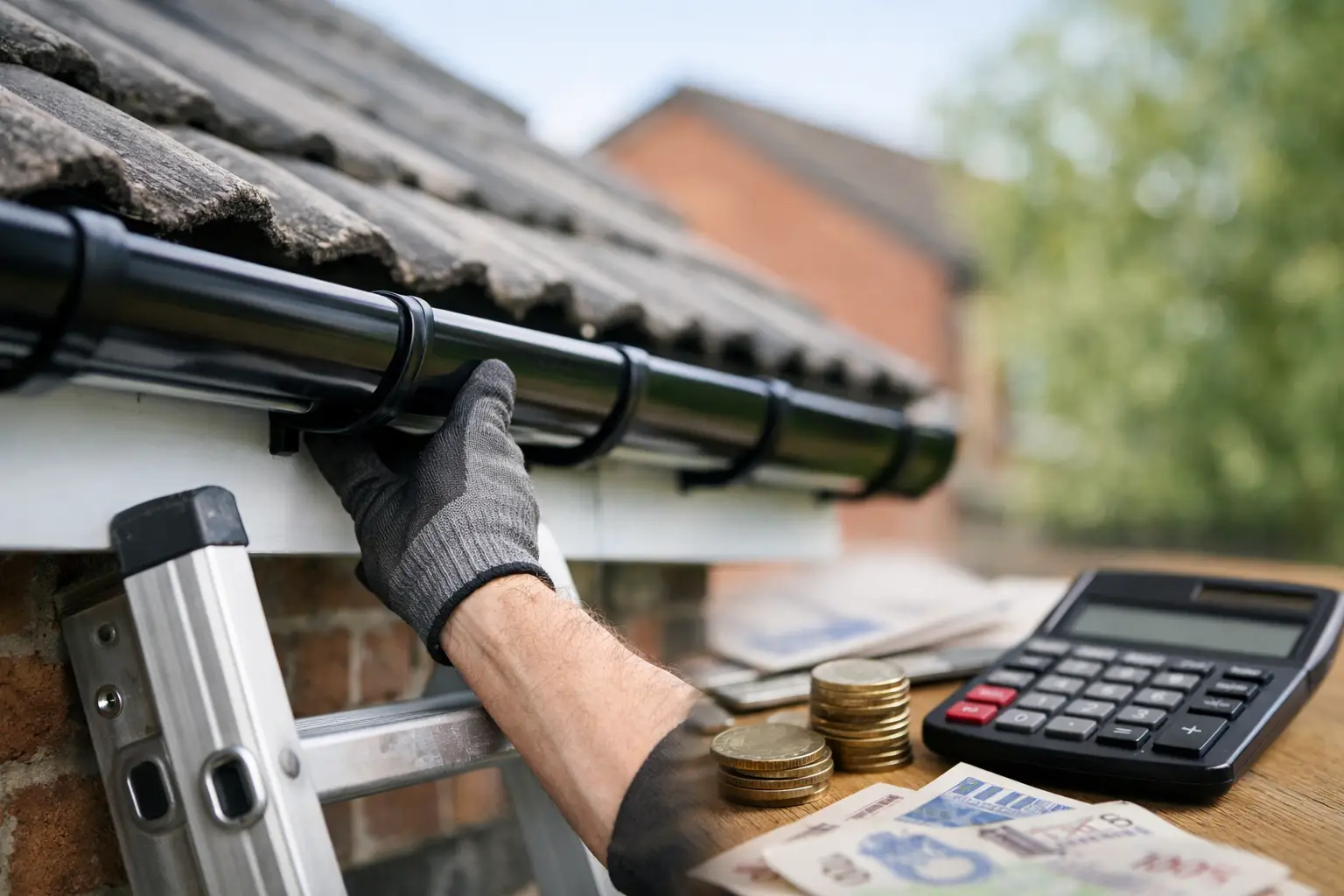
When gutters start overflowing every time it rains, the question usually comes quickly – repair them again, or replace the lot? For many homeowners, gutter replacement cost UK is less about finding one fixed price and more about understanding what pushes the job up or down and whether the spend is worth it.
A proper answer depends on the house, the access, the material, and the condition of the rest of the roofline. A small mid-terrace with straightforward access is a very different job from a larger detached property with tired fascias, awkward corners and old brackets pulling away. That is why quotes can vary so much, even when the work sounds similar on paper.
What is the average gutter replacement cost UK homeowners pay?
As a rough guide, replacing guttering on a typical house in the UK often starts at a few hundred pounds for a simple section and can run into the low thousands for a full roofline job. For a standard semi-detached house, many homeowners will see figures somewhere around £500 to £1,200 for gutter replacement alone, depending on length, access and materials.
For a detached house, the price is usually higher because there is simply more guttering to remove and fit. If the downpipes are also being replaced, or if the installer needs specialist access equipment, the total rises again. On larger homes, or where scaffolding is needed, costs can move well beyond that range.
The key thing is this – there is no single national price that tells you what your own property will cost. Any honest contractor should look at the building properly before putting a figure on it.
What affects gutter replacement cost UK prices most?
The biggest factor is the size of the property. More metres of guttering means more materials, more fittings and more labour. A bungalow with easy ladder access can be quicker to complete than a three-storey townhouse, even if the overall run is similar.
Access matters more than many people realise. If conservatories, extensions, narrow passages or uneven ground make the work harder, the fitting time goes up. In some cases, towers or scaffolding may be the safest option, and that changes the cost straight away.
Material also plays a part. Most homeowners choose uPVC because it is affordable, tidy and does the job well. Aluminium, cast iron effect systems and other premium options cost more. They can suit certain properties better, but they are not always necessary.
Then there is the condition of what sits behind the guttering. If the fascias and soffits are rotten, warped or no longer secure, replacing only the gutters may be a short-term fix. New guttering needs solid support. If the boards are failing, it often makes better sense to tackle the full roofline at once rather than pay for separate jobs months apart.
Typical price ranges by type of job
If you are replacing a single damaged run of guttering, perhaps on the rear of the house, the cost may stay relatively modest. A small section with one downpipe could be a few hundred pounds if access is simple.
A full replacement on a terraced house is usually more manageable than on larger homes because there are fewer elevations and often less overall guttering. A semi-detached house tends to sit in the middle of the range. Detached properties, especially those with bays, garages and extensions, usually cost more because there are more corners, unions, outlets and downpipes involved.
It is also worth separating gutter-only work from full roofline replacement. If you are replacing gutters, fascias and soffits together, the price naturally rises, but the value can be better overall. Labour is consolidated into one visit, the new system works together properly, and you avoid fitting fresh guttering onto old boards that may not last.
Repair or replacement – which is better value?
This is where many homeowners get caught out. A cheap repair can be good value if the problem is isolated – a loose bracket, one leaking joint, or a short cracked section. If the rest of the guttering is sound and correctly aligned, repairing it is often the sensible option.
But repeated patch repairs on old guttering can end up costing more over time. If joints keep leaking, sections are sagging, water is overshooting because the fall is wrong, or the plastic has gone brittle with age, replacement is usually the better long-term decision.
You also need to think about what the leaking water is doing to the property. Overflowing gutters can stain brickwork, soak walls, damage pointing and create damp issues around openings and roof edges. A job that feels easy to postpone can lead to bigger bills elsewhere.
Material choices and how they change the price
Most domestic properties are fitted with uPVC guttering because it offers a practical balance between cost and durability. It is widely available, suits most house styles and is usually the most budget-friendly route.
Aluminium costs more, but it is stronger, longer lasting and often chosen where a neater, more durable finish is wanted. Cast iron or cast iron effect systems can also be an option on older or period-style homes, though these come at a higher cost again.
The cheapest option is not always the best one if the property needs something more hard-wearing. Equally, there is no point paying for a premium system where a quality uPVC installation will serve the house perfectly well for years. It depends on the building, the look you want and how long you plan to stay there.
Hidden issues that can add to the bill
Homeowners sometimes ask why one quote is higher than another for what sounds like the same work. The answer is often in the details.
One contractor may be pricing only to swap the visible gutter lengths. Another may have allowed for replacing brackets, outlets, unions, downpipes and clearing debris at the same time. If the existing fall is poor, the new system needs setting out properly rather than simply copying what was there before.
There can also be hidden timber issues. Once old guttering comes off, rotten fascia edges or damaged rafter feet may become obvious. That sort of work is not always visible from the ground, but it affects whether the new system can be fixed securely.
This is why the cheapest quote is not automatically the best value. It helps to know exactly what is included, what is excluded, and what happens if extra issues are uncovered once work begins.
When replacing gutters with fascias and soffits makes sense
If your guttering is old and the boards behind it are stained, soft, flaking or bowing, it is worth considering a full roofline replacement rather than treating the gutters as a separate issue. New gutters are only as reliable as the structure holding them.
On many older homes, especially where timber fascias have not been maintained for years, fitting fresh guttering onto tired boards is false economy. You may save money on the day, but if those boards fail later, the gutters often need removing and refitting.
For that reason, many local homeowners choose to do the job once and do it properly. A full replacement costs more upfront, but it gives a cleaner finish and avoids piecemeal work.
How to compare quotes properly
A good quote should be clear, not vague. You want to know what material is being used, how many downpipes are included, whether old guttering will be removed and disposed of, and whether access costs are part of the total.
It is also worth asking about guarantees. Workmanship matters just as much as materials with guttering, because poor alignment causes problems even with brand new components. A properly fitted system should carry water away cleanly and sit securely for years.
If a contractor is rushing to give a price without looking closely, that should ring alarm bells. Every property is different, and a proper assessment usually tells you more than a quick guess from the driveway ever will.
A local view on pricing and value
In places like Castleford and across West Yorkshire, the weather gives guttering plenty to deal with. Heavy rain, wind-blown debris and winter freeze-thaw cycles all put pressure on older systems. That is one reason why a decent installation matters more than a bargain price.
For homeowners comparing quotes, the aim should not just be to find the lowest number. It should be to get a fair price for work that solves the problem properly, uses suitable materials and leaves the property protected. That is generally where the real value sits.
If you are unsure whether your gutters need a small repair or full replacement, the best next step is a straightforward inspection from a contractor who will tell you plainly what is worth doing and what is not. A good roofer or guttering specialist should give you the facts without dressing it up, so you can spend your money where it actually counts.