

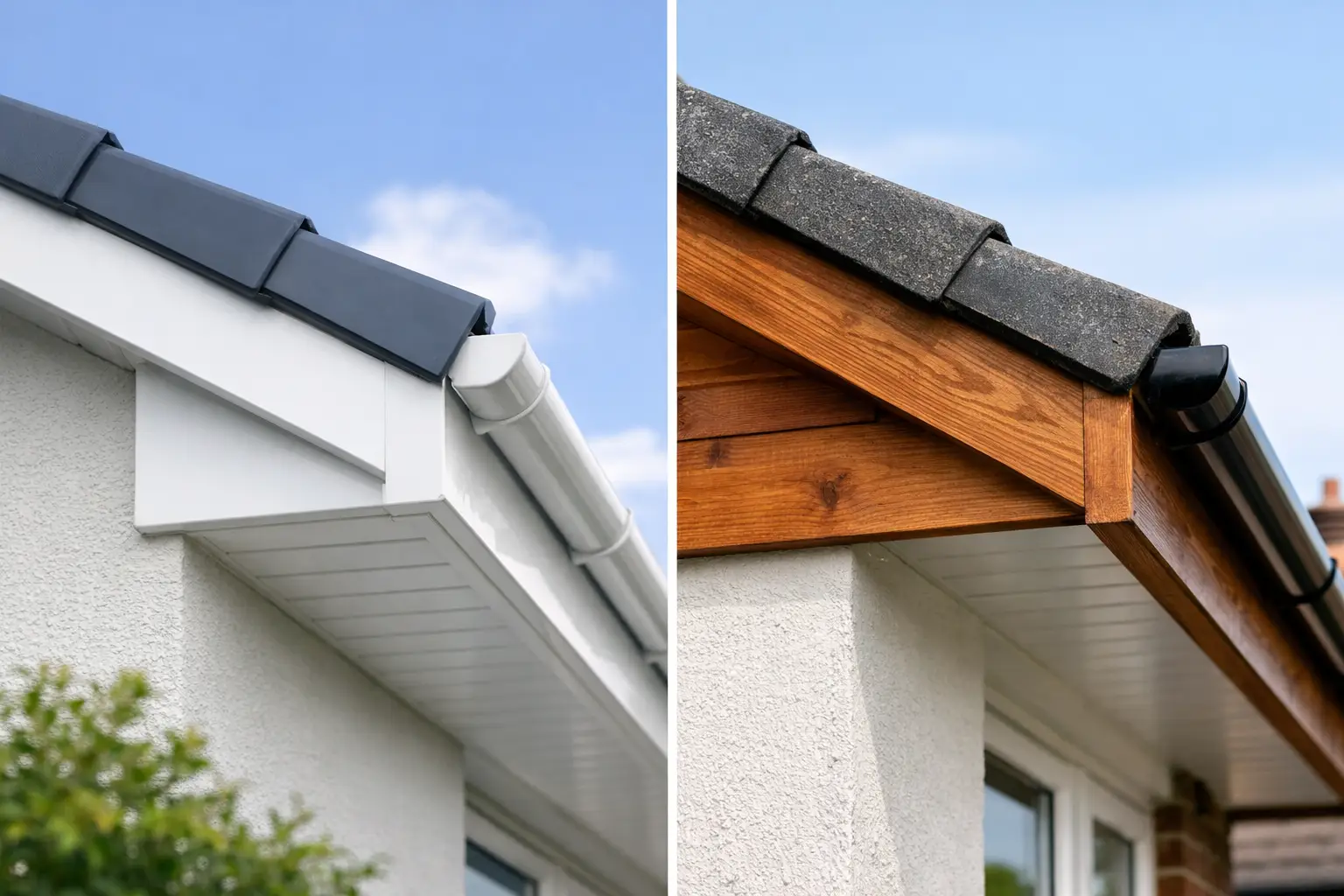
A fascia board may sit just below the edge of your roof, but it has a demanding job. It supports the guttering, helps keep rain out of the roof structure and gives the whole roofline a finished appearance. When old boards start flaking, softening or pulling away from the eaves, homeowners often face the same choice: uPVC versus timber fascias.
There is no one material that suits every property. uPVC is usually the practical choice for homeowners who want a clean finish with very little maintenance. Timber can be the right answer where the character of an older home matters, provided it is fitted and maintained properly. The best decision comes down to the condition of your existing roofline, the style of the property, your budget and how much upkeep you are willing to take on.
What fascias do for your roofline
Fascias are the long boards fixed along the lower edge of a pitched roof. Guttering is normally attached directly to them, which means they deal with constant exposure to rainwater, wind, frost and the weight of a full gutter during a heavy downpour.
They work alongside soffits, which are the panels underneath the roof overhang, and the guttering itself. If any part of this system is failing, water can find its way into the eaves and roof timbers. A small area of rot may therefore be more than a cosmetic issue.
Before choosing a replacement material, the important question is whether the boards behind the gutter are still sound. Covering tired timber with plastic capping boards can hide decay rather than solve it. In many cases, removing the old boards and fitting a full replacement fascia is the safer, longer-lasting approach.
uPVC versus timber fascias: the main differences
The clearest difference is maintenance. uPVC does not rot, needs no painting and can usually be kept clean with a wash from time to time. Good-quality boards also give a consistent finish and are available in white, black, anthracite grey, brown and wood-effect colours to suit different homes.
Timber has a traditional look that is difficult to copy exactly. It can be painted in any suitable exterior colour, shaped to match existing details and repaired in sections where appropriate. However, it needs regular protection from the weather. Without this, paint breaks down, water gets into the grain and rot can take hold, especially around gutter brackets and joints.
Both materials can perform well when installed properly. The difference is that uPVC is generally more forgiving for a busy household, while timber rewards ongoing care.
Maintenance and lifespan
For most homeowners, maintenance is the deciding factor. uPVC fascias should not require painting or staining. Keeping gutters clear and checking the roofline for loose fixings remains sensible, but the board itself is designed to cope with wet weather year after year.
Timber needs a closer eye. Painted fascias should be inspected regularly for peeling paint, cracks, open joints and soft patches. The timing for repainting depends on the exposure of the property and the quality of previous preparation, but it should never be left until the wood is visibly failing. Once moisture gets behind failing paintwork, repairs become more involved.
A well-fitted uPVC system can offer decades of service. Properly maintained timber can also last a long time, but its lifespan depends much more heavily on paint condition, ventilation and prompt repairs. On an exposed elevation, this difference can be significant.
Appearance and property style
Timber is often chosen for period homes, cottages and properties with original timber joinery. If the house has painted bargeboards, traditional details or a conservation-led appearance to preserve, real wood may be the more appropriate material. It can look right from close up as well as from the street.
uPVC suits many modern and traditional homes, particularly where a neat, uniform, low-maintenance finish is the priority. Woodgrain-effect uPVC has improved over the years and can be a sensible compromise, although it does not have the same natural texture or flexibility as painted timber.
It is worth looking at the whole exterior rather than choosing a colour from a sample alone. Roof tiles, window frames, brickwork, gutters and soffits all affect the finished result. Black or anthracite roofline products can look sharp on contemporary properties, while white remains a popular and practical option for many homes around Castleford and the wider district.
Cost now and over time
Initial prices vary with access, roof height, the amount of work involved and whether new soffits, gutters and downpipes are included. Timber can cost more over time because it needs preparation, painting and future maintenance. If rotten sections need replacing later, there may also be scaffold or access costs to consider.
uPVC is often the more predictable option. The initial installation is not always the cheapest possible solution, particularly when old boards must be fully removed, but future upkeep is usually limited. For homeowners planning to stay in the property, that reduction in maintenance can make a full uPVC roofline replacement good value.
The cheapest quote is not always the best comparison. Ask whether the price includes removal of old materials, replacement of any damaged rafter ends, ventilation where needed, new guttering and disposal of waste. A proper quote should make clear exactly what will be fitted and why.
When timber fascias are worth choosing
Timber should not be dismissed as old-fashioned. It remains a sound choice where its appearance is important and the homeowner is prepared to look after it. It may also be required where matching existing features or meeting planning conditions matters.
Choose timber when retaining the original character of the building is the priority, particularly if nearby joinery and roof details are already timber. It can also make sense for smaller, carefully detailed repair work where replacing one sound section with a matching material is better than changing the whole roofline.
The key is preparation. Timber fascias should be made from suitable, treated material and fitted with care around joints, gutter brackets and ventilation. They need a reliable paint system applied to dry, properly prepared wood. Cutting corners at this stage usually leads to early problems.
When uPVC is the better practical option
uPVC is usually the straightforward answer for a full roofline replacement on an ordinary family home. It is clean, durable and does not create a recurring painting job at roof level. For properties with ageing, rotting boards and leaking gutters, replacing the fascia, soffit and guttering together can deal with several issues in one go.
It is particularly useful where access is awkward or where homeowners do not want to arrange regular exterior decorating. With correct fitting, suitable ventilation and secure gutter support, uPVC offers a tidy finish that stands up well to the Yorkshire weather.
Quality still matters. Thin capping boards fitted over decayed timber are not the same as full replacement boards. The roofline must be strong enough to carry the guttering and allow water to drain correctly. A professional inspection should identify any hidden timber decay before work starts.
Do not ignore ventilation and gutter condition
Material choice is only part of the job. Roof void ventilation helps reduce condensation, which can otherwise affect roof timbers and insulation. The required approach depends on the roof construction, so it should be assessed rather than added as an afterthought.
Guttering should also be checked at the same time. Sagging lengths, poor falls, leaking joints and blocked downpipes can send water back against a new fascia board. There is little benefit in fitting a fresh roofline while leaving a gutter system that overflows in heavy rain.
If you are replacing fascias because of damp staining, peeling paint or visible rot, have the eaves, felt support trays and rafter ends inspected too. Finding the cause of the problem before covering it up is what protects the roof properly.
Getting the right answer for your home
For most homes, uPVC offers the best balance of cost, appearance and low maintenance. Timber remains the better choice where authentic character is essential and regular upkeep is acceptable. Neither option will perform as it should if the installation ignores rotten timber, poor ventilation or failing guttering.
A careful roofline survey is more useful than a quick look from the ground. At 5 Towns Roofing, we assess the full condition of the fascia, soffit and guttering so homeowners can choose a solution based on the work their property genuinely needs. A sound roofline is not about the material alone – it is about keeping rainwater where it belongs, outside your home.